
Before We Can Rebuild Democracy, We Have to Rebuild Trust
That job belongs to each of us.
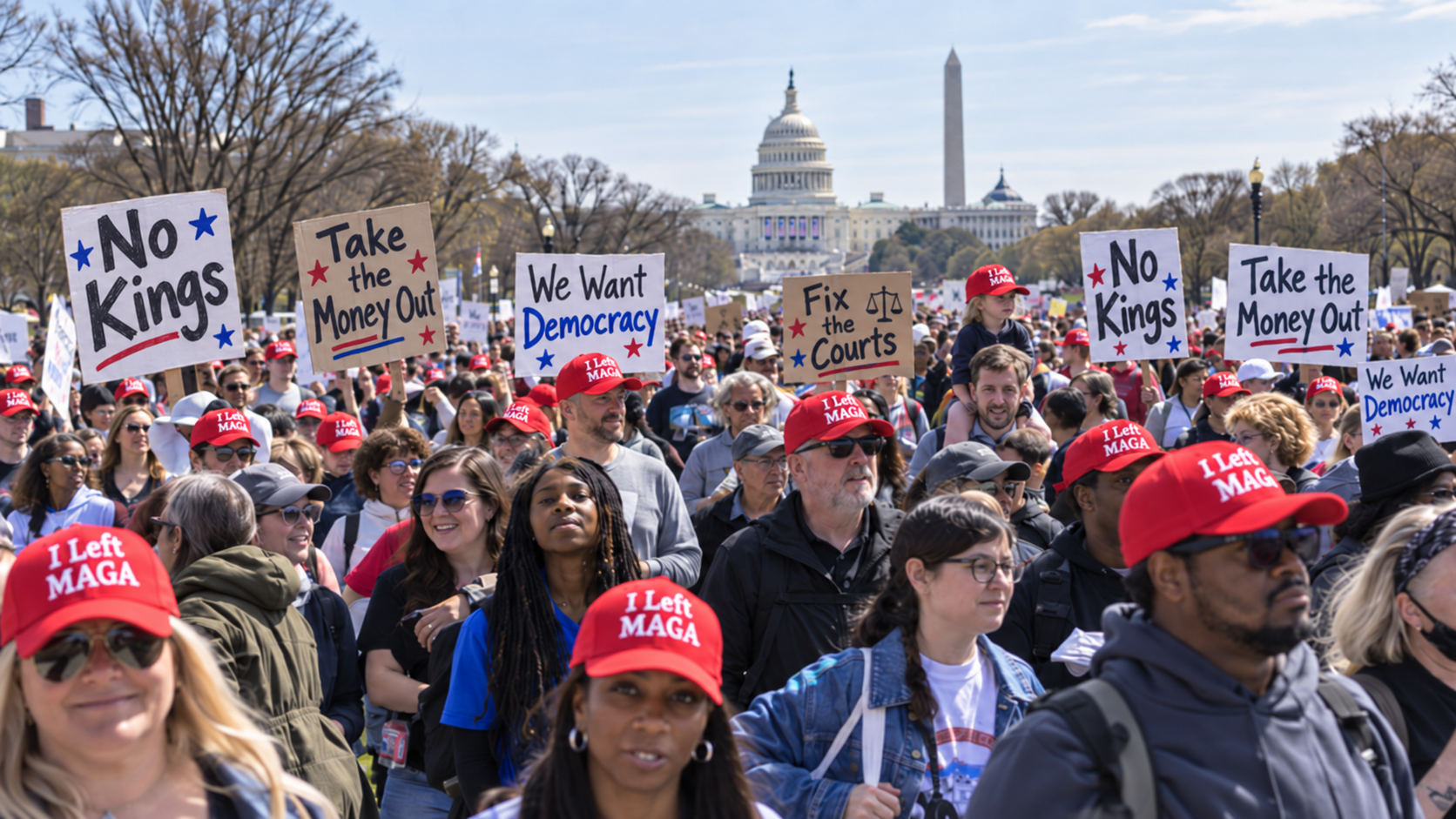
Historians and pro-democracy pundits are talking a lot right now about what comes next — assuming we win the next few elections — and how we make sure an authoritarian movement can't threaten democracy this easily again. Most of the proposed fixes are structural: stronger voting protections, limits on executive power, campaign-finance reform, independent courts, better checks and balances.
But democracy doesn't run on laws and institutions alone, and we are skipping over something more fundamental. Democracy depends on something harder to see — trust. People who trust each other enough to live together, solve problems together, and see each other as fellow citizens.
That trust has been weakening for decades, worn down by the combined forces of unregulated capitalism, the growing concentration of wealth and political power, and propaganda that convinced us to accept it—and turned us against one another.
Capitalism generated enormous wealth, innovation, and opportunity, and that should be dismissed. But over time, economic progress was mistaken for human progress, while community, dignity, purpose, and human flourishing were treated as naive. Our worth became tied to our usefulness to the market, and we learned we could do everything right and still be spit out of the machine. That uncertainty made the future feel less like something we're building together and more like something we're each trying to survive alone.
At the same time, wealth became concentrated in fewer hands, bringing enormous political influence with it. As economic and political power became more intertwined, it became harder for ordinary people to believe that government and other institutions were working for them.
Propaganda evolved alongside these changes. Over time, it and capitalism increasingly fed off one another. Media ownership became more concentrated among large corporations and billionaire owners. At the same time, social platforms built their algorithms around engagement, rewarding the fear, anger, and conflict that capture attention and make money. Rhetoric that once would have been fringe became easier to manufacture, spread, and normalize. Propaganda did double duty: defending the new economic order while redirecting anger over its consequences at each other.
Together, these forces left people more insecure, less trusting, and less connected to one another. An already uncertain population became easier to divide: instead of being told what was happening to us, we were told to blame each other. Left and right, urban and rural, white-collar and blue-collar became bins we were sorted into, reduced to caricatures someone else created.
So we stopped talking to each other. Friends steered clear of politics. Families learned which topics to skip. Relationships were destroyed. That may have helped us avoid difficult conversations in the short term, but it left us, and our democracy, even more vulnerable to those who divided us in the first place.
So what to do?
None of this makes the conversations about institutional reform less important. Laws can protect elections, regulations can rein in concentrated power, and government can strengthen democratic institutions. But reform also requires a trusting and cooperative society.
Our preferred version of democracy won't happen while half the country sees the other half as an existential enemy. We have to see each other as people again before we can organize around anything — and that starts with individual conversations that rebuild trust, creating the environment for collective action. That part of rebuilding democracy belongs to us.
We start by talking again—not just with those who already agree with us, but with the young adults, politically disengaged people, and Trump supporters in our lives. Not to lecture them or win an argument, but to engage or reconnect. To listen. To understand what they fear, what they have experienced, what they think has gone wrong, and why some have checked out.
Those conversations can lead to bigger questions that start connecting dots: Why are so many of us financially insecure? How have wealth and political power become so concentrated? Who benefits from keeping us divided? Are our neighbors or the vulnerable really the source of the problems we share? And what role has propaganda played in all of this?
Yes, these conversations have proven difficult in the past, especially with Trump supporters, but that’s because we didn’t know how to have them. We didn’t know there were proven, straightforward ways to reach those caught in propaganda:
Our Conversation Guides:
The basics - check them out to see if you can imagine yourself using them
Having the proper mindset going into these conversations makes all the difference
If needed, a more detailed, step-by-step look
An example of how to fact-check a Trump supporter
Additional motivations for these conversations
Other Resources:
These conversations matter far beyond any single election. But with the November 2026 elections approaching amid serious threats to election integrity, they matter right now. The sooner we start talking, the better our chance of that “too big to rig” win we need in November.